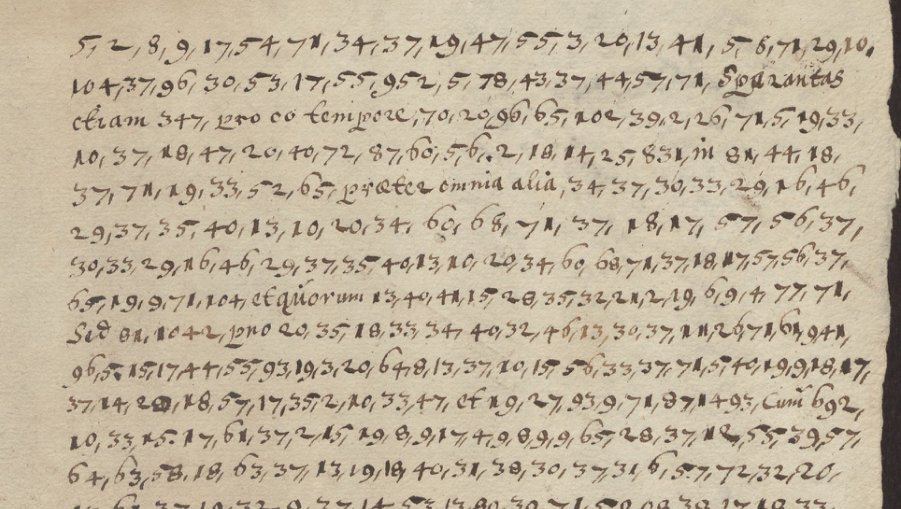
An alphabet preserved in another archival record turns parts of R4284’s
numbers into words. Here is what the independently checked match reveals—and what it does not.
Published 25 October 2026 · Updated 26 October 2026 · By Dolly Moulekhi · Research in progress
Among the numbers in this historical letter is a phrase that can be read as
nobis et patriae securum: “safe for us and our country.”
It emerges when the numbers are replaced with letters using an alphabet strip
in a separate key record, R4325. Other passages yield Swedish instructions and
references to heirs, friends, and relatives.
This archival-key match has been independently checked and accepted by Cyphersolver,
but it is not a complete translation.
The useful result is a set of readable passages within a still-fragmentary letter.
The examples below separate what the program produces from the editorial work
needed to understand it.
R4284 is held at Riksarkivet, Sweden, under Chifferklaver låda II:114.
Its numerical text mixes cipher groups with Latin words written openly.
Those already-readable words are part of the source, not a decoding achievement.
This opens the manuscript crop hosted with
Daniel Bourdeau’s earlier write-up.
Image credit: Riksarkivet, Stockholm, via DECODE R4284.
It shows the opening lines, not the whole letter.
Open the DECODE source record.
The numerical passage examined here is on I25750, right page, with its
continuation on I25751, upper left. Other letter-cipher material on the
images is outside this result.
Why a link rather than an embedded scan? Image reuse terms
have not been established for this release. The image stays at its source;
this site does not copy or automatically load it.
The record dates the material broadly to the seventeenth century. A more specific
1628/Camerarius association appears in earlier work on an archival annotation,
but the date, writer, and recipient are not established by this decipherment.
One worked example
From numbers to “safe for us and our country”
The proposed key is the horizontal alphabet strip below the first square
grid on I25940 in R4325.
It gives several numbers for each letter. For example, 65 gives n,
40 gives o, 28 gives b, 2 gives i, and 19 gives s.
The cipher numbers
Selected numeric run from transcription line 28, after the already-clear word quam.
The program substitutes letters. It does not supply spaces or translate the phrase.
The editorial reading
nobis et patriae securum
Spaces are added by a reader; the letters are unchanged.
The provisional English meaning
“Safe for us and our country.”
This is a phrase within an incomplete sentence, not a translation of the entire letter.
Read the result
What comes out of the cipher?
These are selected short passages, not a continuous letter assembled from disconnected
fragments. Each example shows literal output, a reading with editorial spaces, and a
provisional English gloss. Line numbers refer to the working transcription file,
not archival foliation. No proposed digit splits are used in these examples.
Safety for “us and our country”
Line 28 · Latin
Literal outputnobisetpatriaesecurum
nobis et patriae securum
“Safe for us and our country.”
The words are readable, but this fragment alone does not identify who “us”
refers to or what arrangement would provide that safety.
An instruction to the recipient
Lines 33–34 · Historical Swedish
Literal outputbeflitaederatdetmotteskee
beflita eder at det motte skee
Approximately, “endeavour to ensure that it happens.”
This sounds like an instruction. The phrase by itself does not tell us
exactly what the recipient is being asked to achieve.
Ports in the Baltic Sea
Lines 37–38 · Historical Swedish
Literal outputsåmångahamnarinneiöstersiön
så många hamnar inne i Östersiön
Approximately, “so many ports in the Baltic Sea.”
This is a geographic clue, not an identification of a treaty or campaign.
The excerpt does not establish who holds the ports. Capitalization of the
sea’s name is editorial.
The preceding syntax is unresolved. We cannot yet say whose heirs these
are or what benefit or obligation is being discussed.
A closing communication
Lines 50–51 · Historical Swedish
Literal outputcommuniceramedederfördennagången
communicera med eder för denna gången
Approximately, “communicate with you on this occasion.”
This phrase occurs in the continuation. Its surrounding wording and the
final groups remain uncertain; no signature or sender is recovered here.
For readers who do not know Swedish or Latin
Read it in English
Here are the selected readable parts in English, in their order in the letter.
These are provisional translations of separate fragments,
not a continuous translated letter. Text before, between, and after them
is omitted here; some of it remains unread. The ellipsis within the heirs
excerpt marks an unresolved connection.
Line 28
“Safe for us and our country.”
Lines 33–34
“Endeavour to ensure that it happens.”
Lines 37–38
“So many ports in the Baltic Sea.”
Lines 45–46
“Heirs … as for their friends and relatives.”
Lines 50–51
“Communicate with you on this occasion.”
The passage-by-passage results above show the
corresponding Swedish/Latin output and the uncertainty around each gloss.
The English wording is editorial interpretation; the decoder itself only
substitutes letters for numbers.
Follow the letter line by line
Opening · Lines 10–18
10–11: Too unclear for a dependable English reading.
Includes <952> and a doubtful already-clear Latin
word possibly related to “hoping.”
12: “Also […] <347> […] for the
time being […]” followed by an incomplete Swedish phrase.
“Also” and “for the time being” translate already-clear Latin.
13–14: “[…] <831> […] in the
Baltic Sea […] besides all other […]” The “besides” phrase was already clear.
14–17: Tentatively: “[…] means which would take too
long to enumerate […] and which we shall not forget.”
Repetition and anomalous letters make this reconstruction uncertain.
18: “But […] <1042> […] as a last
[resort?] […] <941>.” “Resort” is a contextual guess,
not a recovered word.
Negotiations and conditions · Lines 19–28
19–20: “[…] negotiate […] honourably and safely
<1493?> […] <692>.”
The grammatical connections are unclear.
21–22: Tentatively: “[…] you would thereby render
us a welcome service […]”
22–24: “And […] it could happen […]
<208> […] with retention […]”
The intervening wording and the retention phrase are not securely read.
25: “[…] of everything taken away […]”
followed by uncertain text.
26–27: Tentatively: “[…] as your instructions
indicate […] would be […] advantageous to the state […]”
28: “[…] and safe for us and our country.”
An already-clear Latin “both … and …” construction spans the preceding
lines, but the complete sentence is not established.
Places, danger, and instructions · Lines 29–36
29–30: “Under this […] <608>
[…] since otherwise […] danger to us […] from <706>
[…] <965> […]”
These are fragments, not a dependable sentence.
31–32: “[…] some other place […] if we were to
abandon those places […] at least […] <934>.”
33–34: “[…] endeavour to ensure that it happens
[…] with retention […]” What “it” refers to remains unknown.
35–36: “[…] <1400> […]
according to the [instructions/arrangement?] we made with you […]
<1302> […]”
The bracketed wording is a tentative contextual interpretation.
Baltic ports · Lines 36–40
36–38: “[…] <1302> […]
already have so many ports in the Baltic Sea […]”
39–40: Tentatively: “[…] it is not advisable to
relinquish them […] In that case <579>.”
The final connective was already-clear Latin. The Swedish wording
contains anomalies, so “relinquish” is not a settled reading.
Who holds the ports, and precisely what is to be retained or relinquished,
remain uncertain.
People and possible beneficiaries · Lines 41–46
41: “[…] <1336> […]”
The remaining wording is too uncertain for a dependable translation.
42–43: Unresolved groups and damaged wording:
<487>, <336>,
<649>, and <244>.
Isolated words resembling “us,” “person,” and “and” do not establish
a sentence.
44: “<1273> […]
<692> […] but also […] for his/their children
and […]” Part of this construction was already-clear Latin.
45–46: “[…] heirs […] as for his/their friends
and relatives.” The pronouns’ referent and any benefit or obligation
are unknown.
Closing · Lines 49–52
Numbering follows the input file; the jump to line 49 reflects the
continuation heading and spacing, not newly reconstructed missing lines.
49: The opening resembles Latin “these are,” but
contains a letter anomaly. The rest is unclear, including
<7??>.
50–51: “[…] communicate with you on this
occasion […]”
52: Unread ending containing
<800> and <659>.
This guide does not supply the full source transcription or literal
edition. It is an aid to understanding the fragmentary output, not a
replacement for checking that output against the manuscript and key.
In everyday English: what might the writer be trying to do?
The writer appears to be asking the recipient to help bring something about.
The surrounding fragments mention safety for “us and our country” and ports
in the Baltic Sea. Together, these suggest instructions connected with
political or diplomatic business. Heirs, friends, and relatives also appear,
but their part in the matter is not yet clear.
That is an interpretation of the fragments, not another quotation
from the letter. We cannot yet name the parties, identify an agreement,
or say exactly what the recipient was supposed to secure. In particular,
“it” in the instruction remains unidentified; we should not silently replace
it with “a treaty,” “peace,” or “control of the ports.”
What is the purpose of this research?
The immediate goal is to test whether a surviving archival alphabet can
help read a letter for which the earlier investigation had not obtained a
reading. Building on Daniel Bourdeau’s transcription and groundwork, this
project identified the R4325 strip as a candidate alphabet; Cyphersolver
has since independently checked and accepted the match.
The contribution is the testable key match and the passages it reveals—not
a new historical account of a negotiation. The checked match
gives historians a starting point for checking the handwriting, resolving
the remaining codes, and eventually identifying the letter’s full purpose.
Measure the result
How much has actually been decoded?
The numerical letter in DECODE R4284
is held at Riksarkivet, Sweden, under Chifferklaver låda II:114.
Applying the horizontal alphabet strip on image I25940 in
R4325,
Chifferklaver låda II:152, produces sequences readable as historical
Swedish interspersed with Latin.
This is an independently checked correspondence between the alphabet in a surviving key
compilation and the letter. It does not establish that this exact sheet was
used by the writer, or that the compilation's word codes apply to the letter.
729 / 754
Numeric occurrences with alphabet assignments in the reviewed transcription. 96.68% coverage. Accuracy is not measured.
The remaining numeric occurrences are 23 unmarked groups above 108 and two
uncertain readings. The 25 spans already written in clear script are counted
separately. A repeated line is retained in the literal edition; excluding it
gives 707 assignments out of 732 numeric occurrences.
The public R4284 record gives a broad seventeenth-century date range.
A narrower 1628/Camerarius association comes from earlier work on a manuscript
annotation and needs archival confirmation. R4325 is catalogued from 1640.
The alphabet match does not resolve that dating question.
Method and credit
Apply an archived key; preserve what does not fit.
This investigation builds on Daniel
Bourdeau's earlier R4284 attempt, including its transcription and notes.
That attempt tested Latin-scored homophonic searches and two archival keys,
without obtaining a reading. It is not work newly performed or discovered here.
Further trials examined other archived alphabets. The promising match is
specifically R4325's horizontal strip below its first square grid—not that grid.
Its transcription contains 104 distinct assignments in the range 1–108.
Four values, 22, 51, 74 and 89, are unassigned. Y and Z share a value set,
so the literal output preserves (y/z).
Keep the earlier transcription and the image-reviewed version separate.
Apply the fixed alphabet to each unambiguous numeric token.
Preserve clear-script words, uncertain digits and unresolved groups.
Explore exact digit partitions separately, without inserting them into the baseline.
Record both readable excerpts and unresolved readings.
AI assisted analysis, coding, and drafting. The decoder applies explicit
rules; it does not call an AI model to invent or regenerate plaintext.
An AI-suggested reading is not independent historical evidence.
A complete model-by-model chronology has not yet been reconstructed.
Update · 26 October 2026
Independent check: the match holds.
In his review response,
Daniel Bourdeau reports that Cyphersolver independently read the horizontal
strip on I25940 from the DECODE image rendered at 400 dpi. All 104 assignments
agree with the submitted transcription. The check also agrees on the four
unused values, the shared Y/Z column, and the letters å, ä, and ö.
He reports that applying the strip unchanged produces running historical
Swedish with both enciphered and already-clear Latin: the letter is mainly
Swedish, rather than Latin as previously described. He also confirms that
R4325 was among the key records his project had collected but not tried,
attributing the match to this project.
Cyphersolver has accepted the contribution under the method
read after matching with a key from external sources, with credit
to Dolly Moulekhi and transcription credit to the Cyphersolver project.
Its current extent is still decoded, not read: the method
label does not mean that a complete, segmented and translated letter is finished.
The statistical test was inconclusive
Cyphersolver’s separate docs/_validate.py test compared the reviewed
decode with keys fitted to shuffled ciphertext. According to the review,
the decode scored −3.12 per letter, above the best shuffled comparison
(−3.22), but not by the margin required to pass. The reported outcome is
underdetermined, not statistical confirmation.
Bourdeau notes the short text relative to the 104 values, the mixed languages,
and the use of a modern Swedish model. His stated basis for accepting the
match is the surviving archival alphabet applied unchanged and the Swedish
it produces. These are his reported findings; this article does not claim
to have rerun his statistical test.
What has not been established
The English reading aid above remains provisional and is not certified by
this review. Complete word separation and translation are still needed.
The 23 large numeric groups remain unresolved; possible word-code readings
from R4325’s lists require further testing. The frozen literal output and
original control results have not been changed to fit the reviewer’s readings.
All 23 unmarked large-group occurrences remain unresolved. Six have exact
split hypotheses: 941 → 9,41; 965 → 96,5; 934 → 9,34;
336 → 33,6; 649 → 64,9; and 244 → 2,44.
For example, splitting 244 would complete futuris.
That linguistic fit is not proof of an internal manuscript boundary.
Neither 800 nor 1400 can be fully partitioned into assigned alphabet values.
Finding the same numbers in another list does not establish their meanings
in this letter. Apparent anomalies such as nonoblkwiscemur
and haecsunr are retained, not silently corrected.
Technical checks: what the shuffled controls do—and do not—show
The local evidence package runs 1,000 shuffled-key controls and 1,000
within-line shuffles. The score is agreement at 115 positions in the
four originally tested excerpts (safety, the instruction, heirs, and the closing;
not the newly illustrated ports excerpt). The proposed output agrees at all 115 positions;
mean agreement is 4.506 for key shuffles and 13.747 for within-line
shuffles. Each family's maximum is 24.
The reference strings came from this key's own output.
These comparisons are retrospective sanity checks, not independent
language tests or proof of a correct decipherment. Both controls preserve
alphabet coverage. The already-inspected continuation is not a held-out test.
Corrections and limits
An earlier “733/754 verified, about 97% complete” claim was withdrawn.
Alphabet coverage is not accuracy. Earlier tentative dictionary substitutions
were also not established. The key check described above does not certify
the complete translation or every cipher-token transcription. No exhaustive
priority claim is made. Separate letter-cipher material on the images
is outside this result.
Inspect the computation
A reading should be checkable without an AI model.
This is a code-only download, not the full evidence package.
It contains a standard-library decoder, synthetic tests, and instructions.
Supply your own permitted transcription and key JSON to reproduce literal decoding.
It does not include the full transcription, key data, or shuffled-control inputs.
The public text-only evidence package
contains original/reviewed transcriptions, all literal lines, token-by-token
alignments, the key, uncertainty ledger, scripts, and retrospective control results.
Daniel Bourdeau permitted transcription reuse with credit
on 25 October. Download the gist files together and follow its README.
The ZIP above remains code-only; archive images remain linked, not redistributed.
Corrections should identify the image, line and token, show the proposed
alternative, and distinguish visible evidence from linguistic expectation.
Systematic failures on image-confirmed readings would weaken the key hypothesis.
Cyphersolver’s completed check is documented in the independent-review section.
Sources and credit
This work starts with preserved sources and earlier research.
Riksarkivet, Stockholm. DECODE R4284,
Chifferklaver låda II:114; I25750 right and I25751 upper left.
Riksarkivet, Stockholm. DECODE R4325,
Chifferklaver låda II:152; horizontal strip on I25940.
Daniel Bourdeau / Cyphersolver. R4284 write-up.
Earlier attempt, transcription, notes, and subsequent independent key check.
The earlier write-up’s 822-group count differs from our 754-token numerical-letter scope;
the upstream counting procedure has not been audited here.
Carter Church (2026). Breaking the
Marmont Cipher, 1809. An example of a web write-up with reproducible evidence,
not a source of validation for R4284.
Credit to Riksarkivet for the archival holdings and to DECODE/DECRYPT for access
and research infrastructure. No scans are redistributed here. These credits
do not imply permission, endorsement, or independent verification.